Helping create a seamless transition between Grundfos Remote and Grundfos GO, and creating a UX research plan.
UX researchProject outcome
Delivered a full analysis, research plan, and prioritised recommendations for the Grundfos GO App. The work focused on reducing friction for users moving from the older Grundfos Remote app, especially while some pumps were still only supported in Remote.
Grundfos GO app analysis and research planning
This phase focused on analysing Grundfos GO and planning research for a smoother transition from the older Grundfos Remote app.
Grundfos GO is a professional mobile tool used by installers to set up, monitor, and troubleshoot smart pumps. At the time, some pumps were still only supported in Remote, making Remote still used.
I worked as a UX researcher with a Design Business Lead, Product Specialist, Platform Owner, and Senior Business Designer. Together we delivered an analysis of both apps, suggestions for reducing transition friction, and a research plan for testing those ideas with users.
The research
The mandate
Create a research plan and recommendations for Grundfos GO, with a focus on easing the transition from Grundfos Remote.
Because some pumps were still only supported in Remote, the work needed to define a low friction migration path before full support was available in the new app.
Starting the research
Before any research sessions, it was important to understand the product context. Grundfos GO was still a relatively new concept, so I worked with stakeholders, especially the Global Solutions Manager, to understand the current landscape.
The project sat in a transitional phase. A newer version of the app already existed, but Remote was still necessary because it supported products that GO could not support yet. That dual app situation shaped the research focus.
It was also important to understand restrictions early. One of the main constraints was participant recruitment, which is covered later.
To keep the work moving, I created a UX research delivery process and shared it with stakeholders.
The process mapped four phases:
Understanding
Product analysis
Research planning
Testing the research approach
For each phase, it showed where the Design Business Lead, Product Specialist, Platform Owner, Senior Business Designer, and Global Solutions Manager needed to take part. This made it easier to check availability in advance and find a replacement if someone could not join, so the project would not stall.
Understanding phase
Outcomes
- An understanding of Grundfos Remote and Grundfos GO
- Understand the current issues within both solutions
Grundfos Remote and Grundfos GO analysis
The goal of the analysis was to understand how the move from Remote to GO could feel more seamless. After reviewing both apps, I had a clear concern.
In Grundfos Remote, users could access all connection types from the Remote flow. In Grundfos GO, that was not the case.
Stakeholders had made Bluetooth a standalone action because it was the most used option. Radio was second, and Infrared was third. Usage frequency supported giving Bluetooth more prominence, but the data did not show that users would stop using Radio or Infrared.
Compared with Remote, this made Radio and Infrared harder to find and added extra steps for users who still needed them.
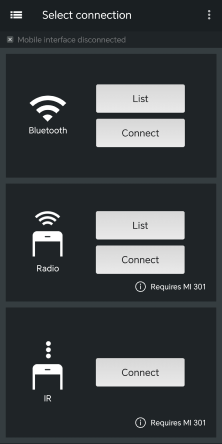
“Even if I'm in a hurry I can see all the connection types I need.”
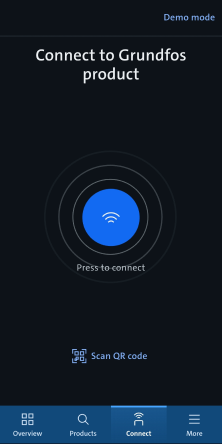
“I'm in a hurry with other installations, but I do not see other connection types, I only understand I can connect via bluetooth, but what if I need Radio or RI?!”
Suggestions
Demo mode
Connect to Grundfos
product
Press to connect
Demo mode
Connect to Grundfos
product
Press to connect
Preparing research
After the analysis, we prepared the research. We agreed to combine user interviews with usability testing.
Stakeholders did not want a long research period and needed answers quickly. A mixed session let us understand users, see how they experienced the current solution, and gather feedback on the new suggestions in one study.
Before running sessions, we defined the interview questions and the structure of the study.
We set two rules:
No more than 10 interview questions
Around 30 minutes for the interview, and 30 minutes for reviewing suggestions
That kept each session within one hour.
The questions focused on:
Experience with Grundfos Remote
Experience with Grundfos GO
Similar experiences with both apps
We also set rules for how questions should be written:
Avoid leading questions such as “What do you like about X?” or “What do you hate about X?”
Avoid yes or no questions such as “Have you used X?”
Instead of pushing users toward a positive or negative answer, we asked open questions such as “What is your overall experience with X?” This made it easier for people to describe their experience in their own words.
Research plan
We prepared a research plan and guideline that included:
Problem statement
Research questions
Research goals
Researchers involved
Interview questions and the reasoning behind them
Guidelines for writing questions
Opening script
Synthesis guideline
Closing script
Recruiting participants
Recruiting was the biggest constraint. It was very difficult to find installers who could spare a full hour because of their schedules.
After discussing this with the Senior Business Designer, we decided to speak with people who manage multiple installers in the field. These participants had experience with pump installation and maintenance. They also needed experience with tools similar to Grundfos GO, because our persona used digital services, especially mobile IoT solutions.
This was a compromise. It still gave us people with relevant field knowledge and more availability, but it was not the same as speaking directly with installers on the job.
We planned for 3 researchers to recruit 2 participants each, for a total of 6. That was enough to look for patterns and inconsistencies.
Mock session
After we had potential solutions, interview questions, and a research plan, we ran a mock session with one internal employee. The session followed the mixed method we had agreed on, a user interview plus usability testing.
I conducted the session together with the Senior Business Designer. We followed the research plan and looked for what could be improved, adjusted, or removed.
The internal employee gave useful feedback during the session. One comment stood out:
“Make the participants feel like they can deliver value.”
That helped us improve the email script we sent to participants and the script we used at the start of the session.
What we made
Before running sessions with participants, we had a set of concrete deliverables ready to use and review:
- A UI suggestion for the GO connect flow, ready to show users during sessions
- A defined UX delivery process for the research work
- A prepared UX research plan
- A clear approach for user interviews and moderated usability studies
What I've learned from this
Working with busy installers also reinforced that research has to fit real constraints. We could not easily recruit installers for one-hour sessions, so we adapted by speaking with people who manage installers and still had relevant field and digital-tool experience. The method itself also had to be practical: combining interviews and usability testing in one hour so stakeholders could get answers quickly.